Parfait
Parfait
Parfait
Aug – OCT 2024
Parfait is an AI-enabled platform that creates custom wigs without the need for salon visits. The brand serves a thirteen-billion, highly fragmented market of wig and extension shoppers in the United States. In mid-2024, Parfait asked us to help define the next generation vision of their product, a concept prototype that would anchor their bridge round pitch and convince investors how far their technology could go. It was a high speed, high stakes storytelling challenge created to secure multimillion dollar funding and a strategic partnership with Ulta Beauty.
Aug – OCT 2024


JUMP TO
0%
My impact
My impact
I led product design for this initiative, shaping the vision, translating early research into a clear narrative, and designing the end to end prototype that helped raise 5M in a bridge round. It not only visualized the future, it gave investors confidence that Parfait could deliver it.
01
Frame the opportunity
02
Design a concept prototype grounded in customer's reality
03
Move from concept to product roadmap
I worked closely with Parfait’s founders, Isoken and Ifueko Igbinedion, with ongoing feedback from our creative director Joshua Vizzacco, and weekly reviews with the Parfait team and Marc Schneider from Ulu Ventures.
Outcomes
Outcomes
$5M
Funding secured following the concept pitch
2.5X
Increase over Parfait’s original 2M target
3
Core features put on 2025-2026 product roadmap
$5M
Funding secured following the concept pitch
2.5X
Increase over Parfait’s original 2M target
3
Core features put on 2025-2026 product roadmap
$5M
Funding secured following the concept pitch
2.5X
Increase over Parfait’s original 2M target
3
Core features put on 2025-2026 product roadmap
Frame the opportunity
The challenge
The challenge
Before this project began, we had already worked with Parfait for four months and had a solid understanding of their product. Then the founders came to us with a new request:
Can you build us a prototype for our next funding pitch? We want to show investors what the future of our product could be. Our goal is to present a vision that goes far beyond our current AI technology and excites the room, including the team from Ulta Beauty. We need your help shaping what this future could look like.
They needed something bold and inspiring, delivered in five weeks and within a limited budget.
Defining the vision
Defining the vision
Defining
the vision
The founders initially suggested positioning the concept around Parfait’s advanced AI tech. It felt intuitive to them because they believed the technology was their key differentiator. I challenged this instinct. A technology-first story rarely resonates unless it is grounded in the human problem it solves.
Customer testimonials and survey data from Parfait’s marketing team revealed a clearer truth. Most of Parfait’s customers are Black women in their late twenties to forties. They do not choose Parfait because they understand the inner workings of the AI. They choose it because it solves persistent problems:
The founders initially suggested positioning the concept around Parfait’s advanced AI tech. It felt intuitive to them because they believed the technology was their key differentiator. I challenged this instinct. A technology-first story rarely resonates unless it is grounded in the human problem it solves.
Customer testimonials and survey data from Parfait’s marketing team revealed a clearer truth. Most of Parfait’s customers are Black women in their late twenties to forties. They do not choose Parfait because they understand the inner workings of the AI. They choose it because it solves persistent problems.
“Fits perfectly,” “looks so natural,” “saves time,” and “shop from home” came up again and again:
The founders initially suggested positioning the concept around Parfait’s advanced AI tech. It felt intuitive to them because they believed the technology was their key differentiator. I challenged this instinct. A technology-first story rarely resonates unless it is grounded in the human problem it solves.
Customer testimonials and survey data from Parfait’s marketing team revealed a clearer truth. Most of Parfait’s customers are Black women in their late twenties to forties. They do not choose Parfait because they understand the inner workings of the AI. They choose it because it solves persistent problems.
“Fits perfectly,” “looks so natural,” “saves time,” and “shop from home” came up again and again:


I created a frequency-based text cloud from customer reviews to surface the themes that mattered most to shoppers.
Align on the path
Align on the path
In collaboration with the founders and the marketing team, I defined a design vision rooted in real customer needs. It showed how the next generation of Parfait’s shopping experience could solve these pain points even more effectively, creating a path for organic growth in a fragmented industry. This vision grounded the team in customer reality and brought alignment at a moment when much still felt uncertain.
Grounding the concept in customer reality
Improve personalization
The first area I focused on was personalization. In conversations with Ifueko, Parfait’s CTO, I learned that the quality of the AI fit scan has the greatest impact on the accuracy of wig fit and lace tint matching. At the same time, the team was managing a high volume of returns, many of which were requests for adjustments. Customers liked the product, but the fit was inconsistent. Solving this was equally important for the business and for customer satisfaction.
Through my audit and user testing, I found that drop-offs clustered in two moments: at the very beginning of the scan and after long pauses during the scan, which often happened when users needed to adjust lighting or camera position. This made it clear that trust and clarity were breaking down at key moments. I focused my investigation on understanding what caused these interruptions.
The first area I focused on was personalization. In conversations with Ifueko, Parfait’s CTO, I learned that the quality of the AI fit scan has the greatest impact on the accuracy of wig fit and lace tint matching. At the same time, the team was managing a high volume of returns, many of which were requests for adjustments. Customers liked the product, but the fit was inconsistent. Solving this was equally important for the business and for customer satisfaction.
Through my audit and user testing, I found that drop-offs clustered in two moments: at the very beginning of the scan and after long pauses during the scan, which often happened when users needed to adjust lighting or camera position. This made it clear that trust and clarity were breaking down at key moments. I focused my investigation on understanding what caused these interruptions.
The first area I focused on was personalization. In conversations with Ifueko, Parfait’s CTO, I learned that the quality of the AI fit scan has the greatest impact on the accuracy of wig fit and lace tint matching. At the same time, the team was managing a high volume of returns, many of which were requests for adjustments. Customers liked the product, but the fit was inconsistent. Solving this was equally important for the business and for customer satisfaction.
Through my audit and user testing, I found that drop-offs clustered in two moments: at the very beginning of the scan and after long pauses during the scan, which often happened when users needed to adjust lighting or camera position. This made it clear that trust and clarity were breaking down at key moments. I focused my investigation on understanding what caused these interruptions.
Key Finding #1
Trust is not established at the start
In testing the existing scan flow, my participant Olivia was asked to follow on-screen instructions while thinking aloud. She briefly looked for a card to hold up, then completed the scan without one. In the debrief, I learned that she did see the instruction, but it did not feel right to her. She also noticed that the scan continued even without the card, which only increased her confusion.
Is it safe to do? Is the AI going to read my card?
What the team first saw as a logistical problem, assuming people did not have cards nearby, turned out to be a trust problem instead. Asking users to hold up a credit card set the wrong tone from the start and made them question whether the tool was safe. When trust is missing, people hesitate, drop out of the flow, or avoid scanning altogether.
The old AI scan asked users to hold a credit card for accurate measurement. This instruction appeared on the title screen, and the video guide reinforced the behavior by using a card during the steps.
Once I understood that trust was the core barrier, I asked a simple question. If the scan already produces the outputs Parfait’s model needs, does the method actually require a physical card? This opened the door to exploring computer vision techniques that rely on head movement instead of objects. Through this research, I found a strong parallel with Warby Parker’s webcam based PD tool, which measures distance using motion rather than a reference card. This shift provided a safer and more intuitive approach that could replace the need for any physical object during the scan.
I reduced the scan to 3 movements and let the backend pull the keyframes needed for KeenTools. This keeps the scan accurate while removing the need for a card and any extra friction.


Step instruction
Horizontal and vertical
capture are step 1 and 2
Guiding tiles
with 4 interactive
states
No card needed, eyes follow moving tile
Alternative method that captures scale approximation data
Step 1 and 2 are horizontal captures, instructions are shown at the top. At each step the interactive guiding tiles inform users of progress with 4 states.
The new design informs what the issue is, how to fix it, as well as how well the user's adjustments are working.
No card is required anymore, the same data needed for scale approximation can be captured with alternative method.
Key Finding #2
Users cannot tell how close they are to fixing an issue
In my audit of the current scan flow, I found that the issue was not the clarity of the instruction but the lack of actionable guidance. The flow told users what to change, yet gave no indication of how far they were from fixing the problem. During testing, I was stuck at a single step for a minute because I could not tell whether I was improving the scan or running into a bug. This kind of static feedback feels like an error state, and it causes people to lose confidence and drop out.


Existing feedback leaves users unsure whether their adjustments are working.
In the concept design, I focused on giving users continuous feedback that shows their progress toward fixing the issue and whether they are moving in the right direction. This helps them feel in control and confident as they adjust.
How to fix an issue
Inform how far user is
from correcting issue
Visual guidance
Name the issue
How to fix an issue
Inform how far user is
from correcting issue
Visual guidance
Name the issue
Improve customization
A review of the existing wig customization flow shows how difficult it is to understand what the final wig will look like. Steps are disjointed, visuals are static, and customers must guess how the pieces fit together.
Key Finding #1
Lack of purchase confidence
During testing, customers struggled to describe the wig they were building and consistently underestimated how it would turn out. One participant rated her confidence a 3 out of 10 after completing the customization steps. This lack of visual clarity contributes to high return rates and comments like “it is not what I thought it would look like.”
From these 4 screens in the existing customization flow, it is difficult to imagine what the final wig will look like. My test participant experienced the same issue.
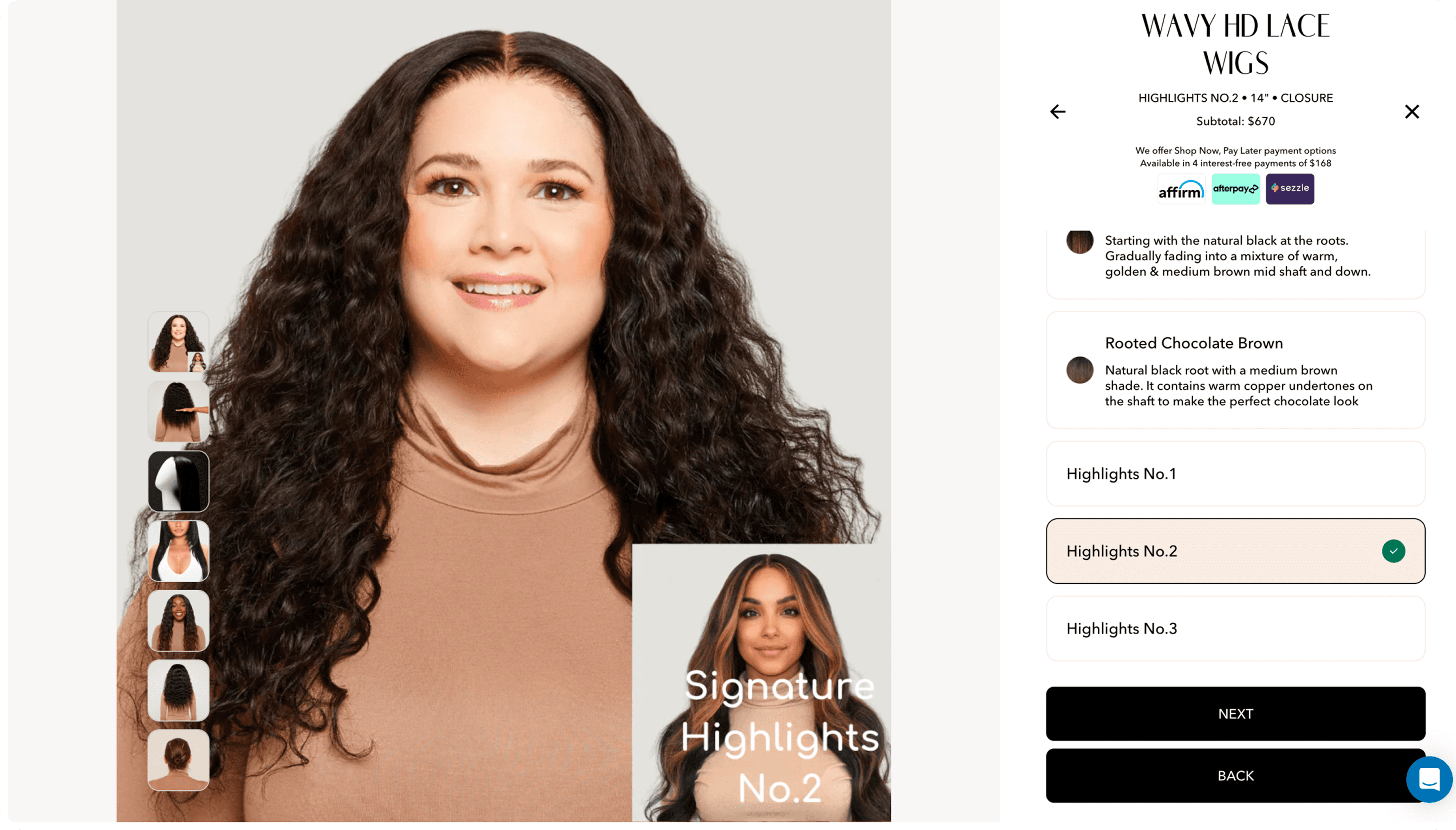
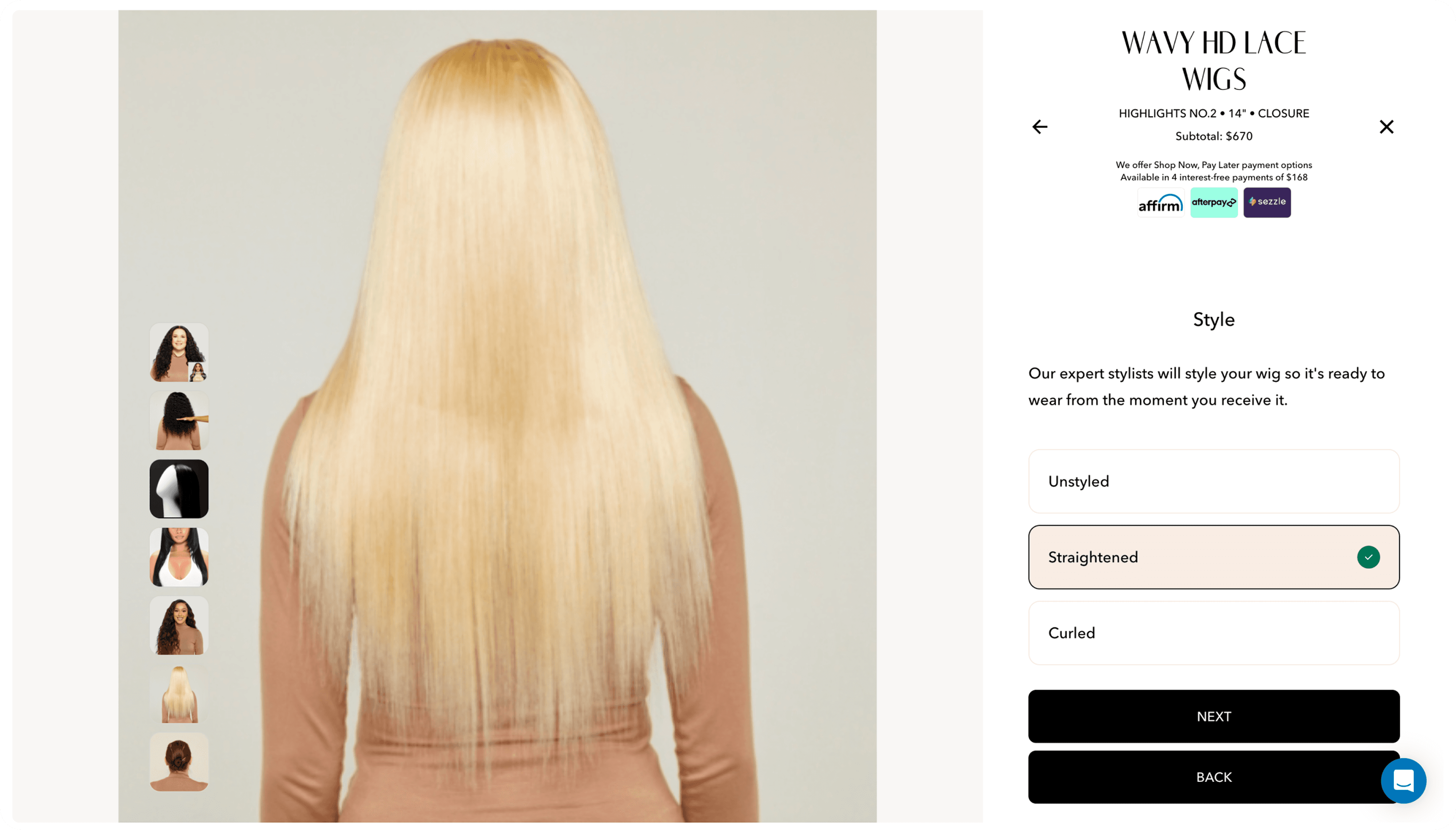
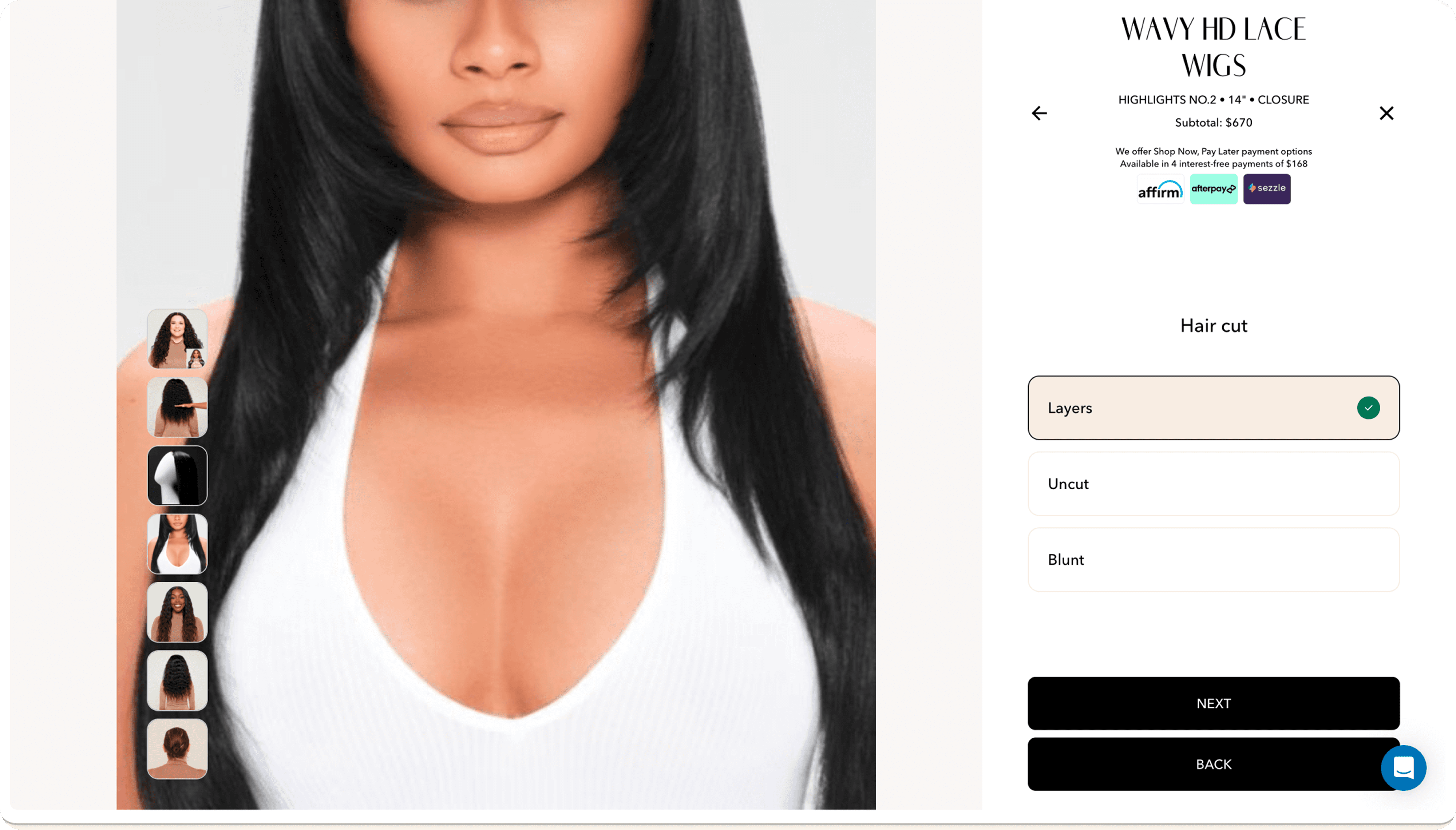
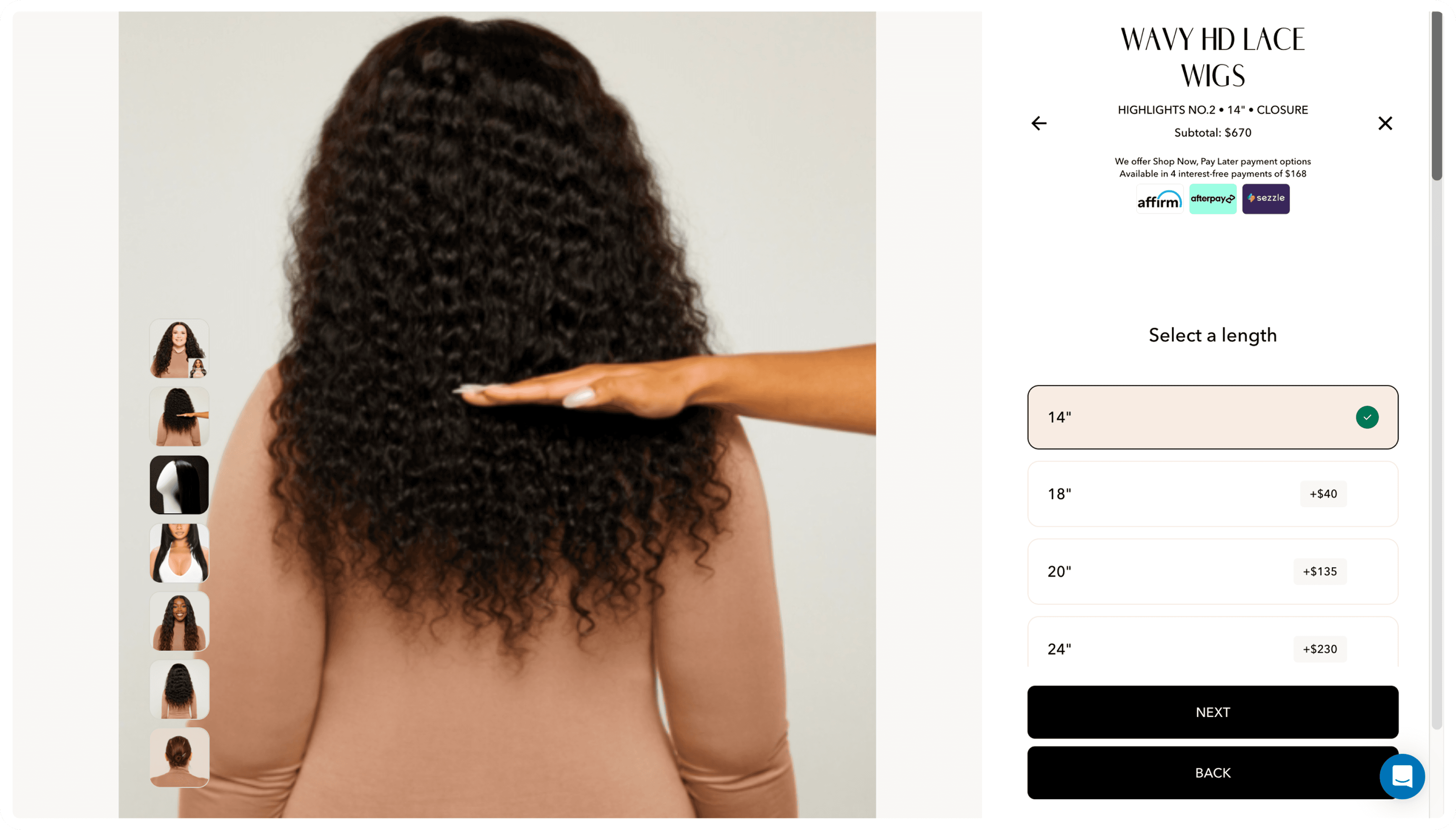
From these 4 screens in the existing customization flow, it is difficult to imagine what the final wig will look like. My test participant experienced the same issue.


From these 4 screens in the existing customization flow, it is difficult to imagine what the final wig will look like. My test participant experienced the same issue.


In the concept experience, what you see is what you get. The wig changes in real time as users adjust anything. Every choice is reflected immediately on the model, which removes guesswork.
Real-time changes
reflected on model
Real-time changes
reflected on model
Three angles
Three angles
Dynamic subtotal
Dynamic subtotal
Clear price impact
Clear price impact
Key Finding #2
Static photos do not support strong purchase confidence
First, seeing a wig on a model is like seeing a haircut on someone else: you might like it, but you have no idea how it will look on you. Second, customers repeatedly ask for the ability to inspect a wig from multiple angles, but the current tools do not support that.
Without a way to confirm these details online, customers place orders, try the wig at home, and return it for adjustments or full refunds. I hypothesize that when customers can see the wig on themselves and explore it from multiple angles before buying, hesitation will decrease and return rates will drop.
I explored solutions using AR and avatar rendering, and recommended an avatar-based try-on for web. After the scan, the system already has all the data needed to render a 3D avatar, making it practical to implement. It also allows customers to return later and try on wigs without turning on their camera each time.
First, seeing a wig on a model is like seeing a haircut on someone else: you might like it, but you have no idea how it will look on you. Second, customers repeatedly ask for the ability to inspect a wig from multiple angles, but the current tools do not support that.
Without a way to confirm these details online, customers place orders, try the wig at home, and return it for adjustments or full refunds. I hypothesize that when customers can see the wig on themselves and explore it from multiple angles before buying, hesitation will decrease and return rates will drop.
I explored solutions using AR and avatar rendering, and recommended an avatar-based try-on for web. After the scan, the system already has all the data needed to render a 3D avatar, making it practical to implement. It also allows customers to return later and try on wigs without turning on their camera each time.
First, seeing a wig on a model is like seeing a haircut on someone else: you might like it, but you have no idea how it will look on you. Second, customers repeatedly ask for the ability to inspect a wig from multiple angles, but the current tools do not support that.
Without a way to confirm these details online, customers place orders, try the wig at home, and return it for adjustments or full refunds. I hypothesize that when customers can see the wig on themselves and explore it from multiple angles before buying, hesitation will decrease and return rates will drop.
I explored solutions using AR and avatar rendering, and recommended an avatar-based try-on for web. After the scan, the system already has all the data needed to render a 3D avatar, making it practical to implement. It also allows customers to return later and try on wigs without turning on their camera each time.
Toggle between
model and avatar
Toggle between
model and avatar
Rotate avatar
Rotate avatar
Current configurations
Current
configurations
Real-time changes are reflected immediately on the model. Users can inspect the wig from 3 unique angles. Price impact are clearly labeled, subtotal are updated dynamically.
Try-on avatar enables customers to see the wig on them, using the 3D avatar created in their likeness from the AI scan. No need to turn on the camera every time.
Concept to product roadmap
Beyond concept
Beyond
concept
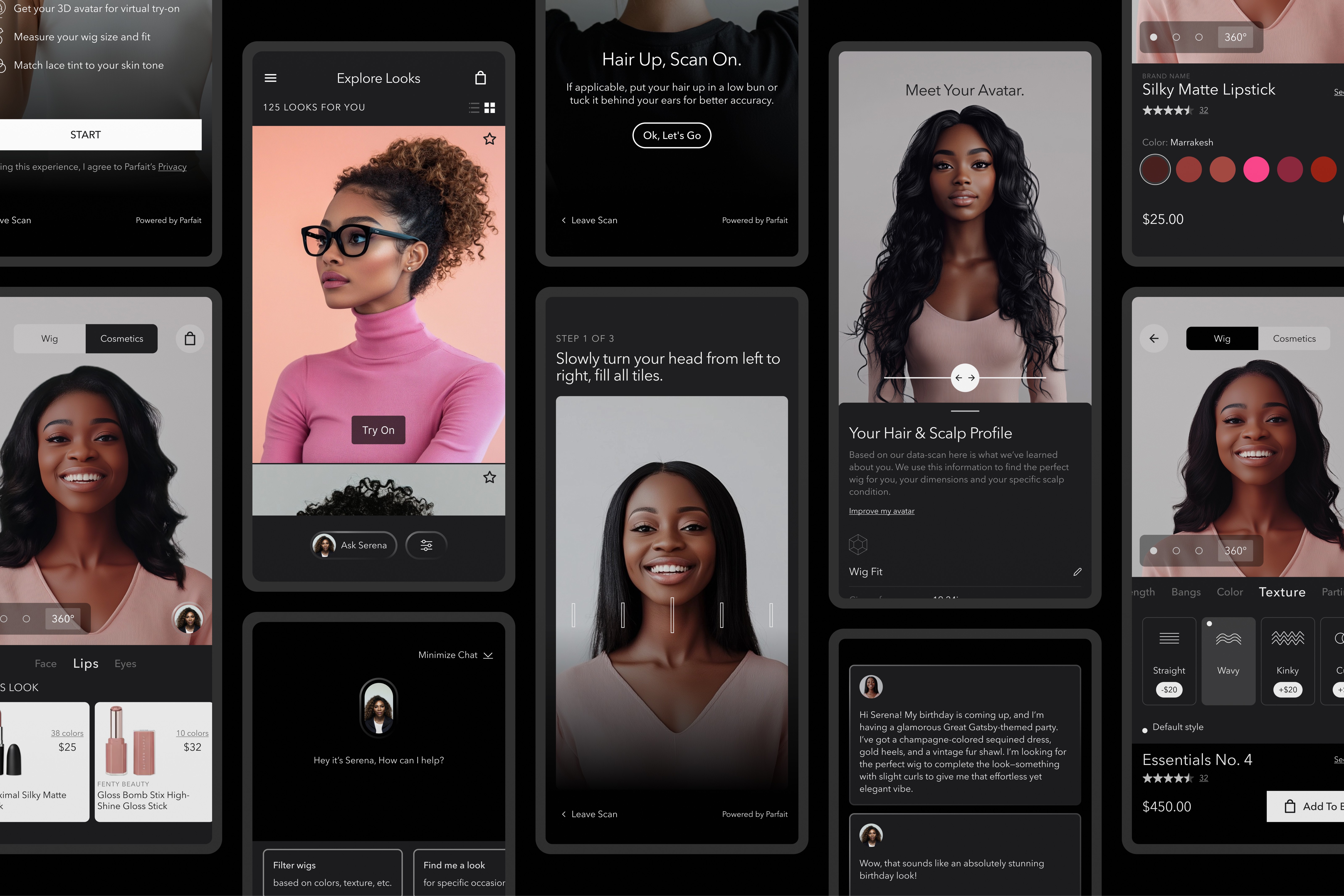
In the concept prototype, I introduced six new features. Three of them are now on Parfait’s official product roadmap for 2025 to 2026.
01
Wig try-on avatar
Wig try-on avatar
Wig try-on avatar
02
3-step AI scan
3-step AI scan
3-step AI scan
03
What you see is what you get wig customization
04
Wig gallery
Wig gallery
Wig gallery
05
AI stylist chat
AI stylist chat
AI stylist chat
06
Cosmetics cross sell
Seven quick design improvements have already been launched on the live site, including removing all references to using a credit card during the scan, adding feedback to adjust lighting and positioning, and displaying the default wig configuration on product pages.
Reflection
Reflection
Wigs are making it easier for more Black women to stay physically active.
On our first day together, Parfait’s founder, Isoken, shared something that stayed with me. Many Black women avoid exercising not because they do not want to, but because washing, drying, and styling their hair afterward takes so much time. Wigs quietly remove that barrier. They give people back hours of their day and make healthy routines feel possible again.
Working on this project reminded me why I care about designing for real problems. It is a special thing when I get to collaborate with women founders who are building solutions from lived experience. Their perspectives resonate with me, especially in a tech landscape where most leaders I meet are cis-gender white men. I’ve made it a goal to use my craft to help more women-led products grow and shape the market.
This was also the first project where I leaned heavily on AIGC to create every media asset. I used MidJourney and ChatGPT to generate all model photography, and RunwayML to animate the characters for motion frames. These tools let me prototype at a speed and fidelity that would have been impossible before, and they helped bring the concept to life with a level of polish that supported Parfait’s vision.
On our first day together, Parfait’s founder, Isoken, shared something that stayed with me. Many Black women avoid exercising not because they do not want to, but because washing, drying, and styling their hair afterward takes so much time. Wigs quietly remove that barrier. They give people back hours of their day and make healthy routines feel possible again.
Working on this project reminded me why I care about designing for real problems. It is a special thing when I get to collaborate with women founders who are building solutions from lived experience. Their perspectives resonate with me, especially in a tech landscape where most leaders I meet are cis-gender white men. I’ve made it a goal to use my craft to help more women-led products grow and shape the market.
This was also the first project where I leaned heavily on AIGC to create every media asset. I used MidJourney and ChatGPT to generate all model photography, and RunwayML to animate the characters for motion frames. These tools let me prototype at a speed and fidelity that would have been impossible before, and they helped bring the concept to life with a level of polish that supported Parfait’s vision.
On our first day together, Parfait’s founder, Isoken, shared something that stayed with me. Many Black women avoid exercising not because they do not want to, but because washing, drying, and styling their hair afterward takes so much time. Wigs quietly remove that barrier. They give people back hours of their day and make healthy routines feel possible again.
Working on this project reminded me why I care about designing for real problems. It is a special thing when I get to collaborate with women founders who are building solutions from lived experience. Their perspectives resonate with me, especially in a tech landscape where most leaders I meet are cis-gender white men. I’ve made it a goal to use my craft to help more women-led products grow and shape the market.
This was also the first project where I leaned heavily on AIGC to create every media asset. I used MidJourney and ChatGPT to generate all model photography, and RunwayML to animate the characters for motion frames. These tools let me prototype at a speed and fidelity that would have been impossible before, and they helped bring the concept to life with a level of polish that supported Parfait’s vision.